Batik in Africa
There are examples of batik textiles in many parts of Africa but the most developed skills are to be found in Nigeria where the Yoruba people make adire cloths. Two methods of resist are used: adire eleso which involves tied and stitched designs and adire eleko where starch paste is used. The paste is most often made from cassava (a root plant) flour, rice, alum or copper sulphate boiled together to produce a smooth thick paste. The Yoruba of West Africa used cassava paste as a resist while the people of Senegal use rice paste. The paste is applied in two different ways.
By using freehand drawing of traditional designs using a feather, thin stick, piece of fine bone or a metal or wooden comb-like tool. This is done by women.
Forced through a thin metal stencil with a flexible metal or wooden tool. This enables accurate repeat patterns to be achieved. This is done by men.
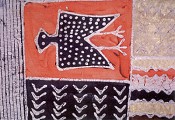
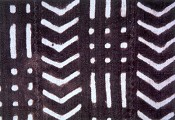
The patterning of cloth is usually a family tradition handed down from mother to daughter as a cottage industry. The cloth is usually divided into squares or rectangles and designs represent everyday tools, carvings, beadwork, activities or traditional images of the artists own culture or tribal history. An eleko cloth is usually made up of two, two and a half yard pieces sewn together.
Many women work alone but group dyeing sessions are more cost effective. The more commercial cloths are the stencil products and are often produced by men. The traditional dye is indigo from a plant which grows throughout Africa. In many places these are now cultivated and different varieties produce a variation of the dark blue colour. Once the paste resist is dry, the fabric is dyed in large clay pots or pits dug in the earth. After drying the paste is scraped off to reveal a white or pale blue design. The usual cloth is cotton but highly prized clothing using wild silk is sometimes produced. In recent years other cloths using African designs have been produced in Britain (Manchester cloths) and Holland. These mass produced fabrics are machine made. Some are now produced in various African countries.
Mud Cloth
This fabric is made by the Bamana people of Mali. The ground fabric is woven of hand spun cotton yarn in narrow strips on the mans double-heddle loom. The cloth is then dyed yellow and the design applied with river mud. This 'saddens' the yellow, turning it dark brown. The yellow dye in the unpainted areas is then discharged with a caustic preparation bleaching out these areas and returning them to their original colour. This produces cloth with the characteristic dark brown and white pattern.
Reproduced from Batik Transitions, published by The Batik Guild, 2006